

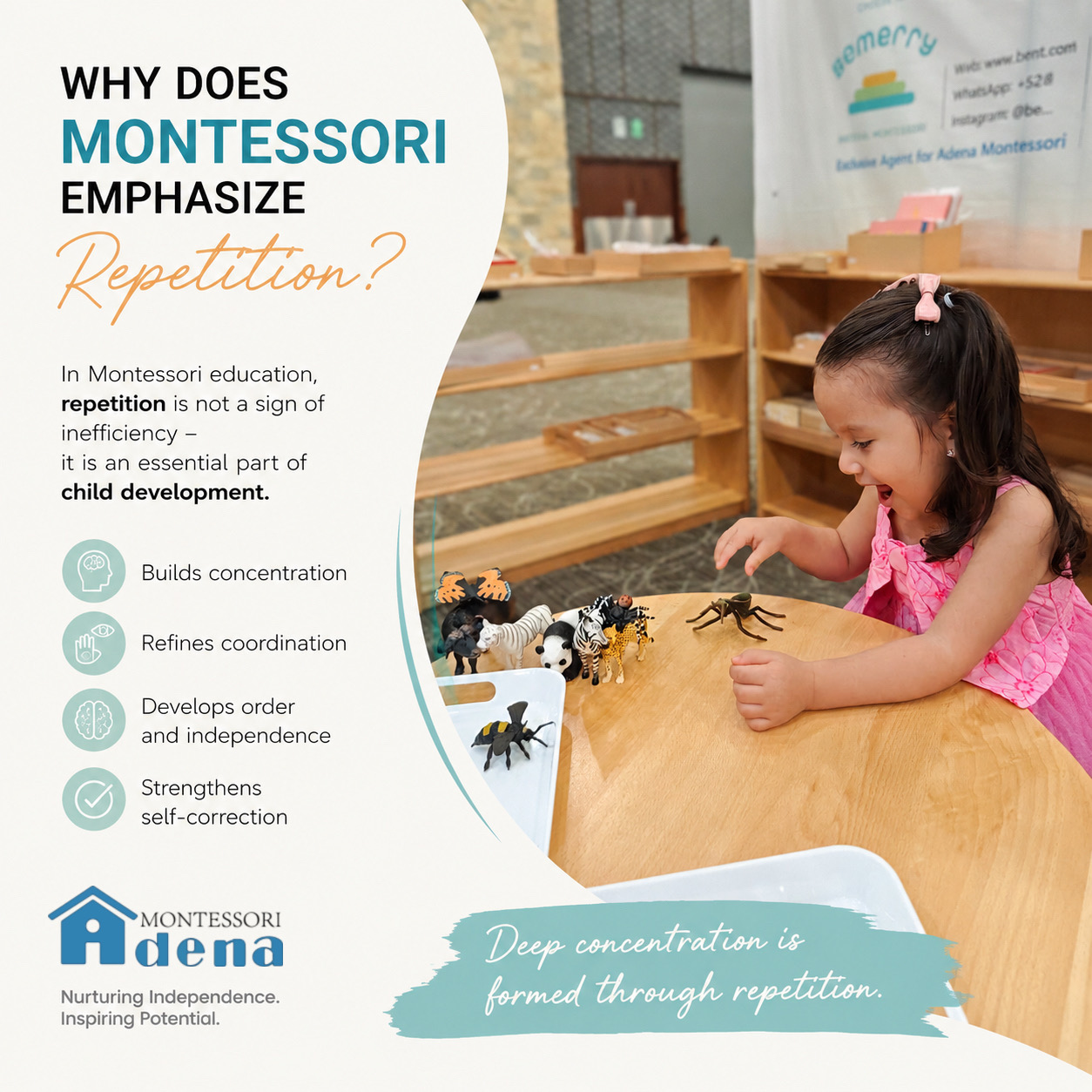
Why Does Montessori Emphasize Repetition?
In a Montessori classroom, it is common to see a child repeat the same activity many times.
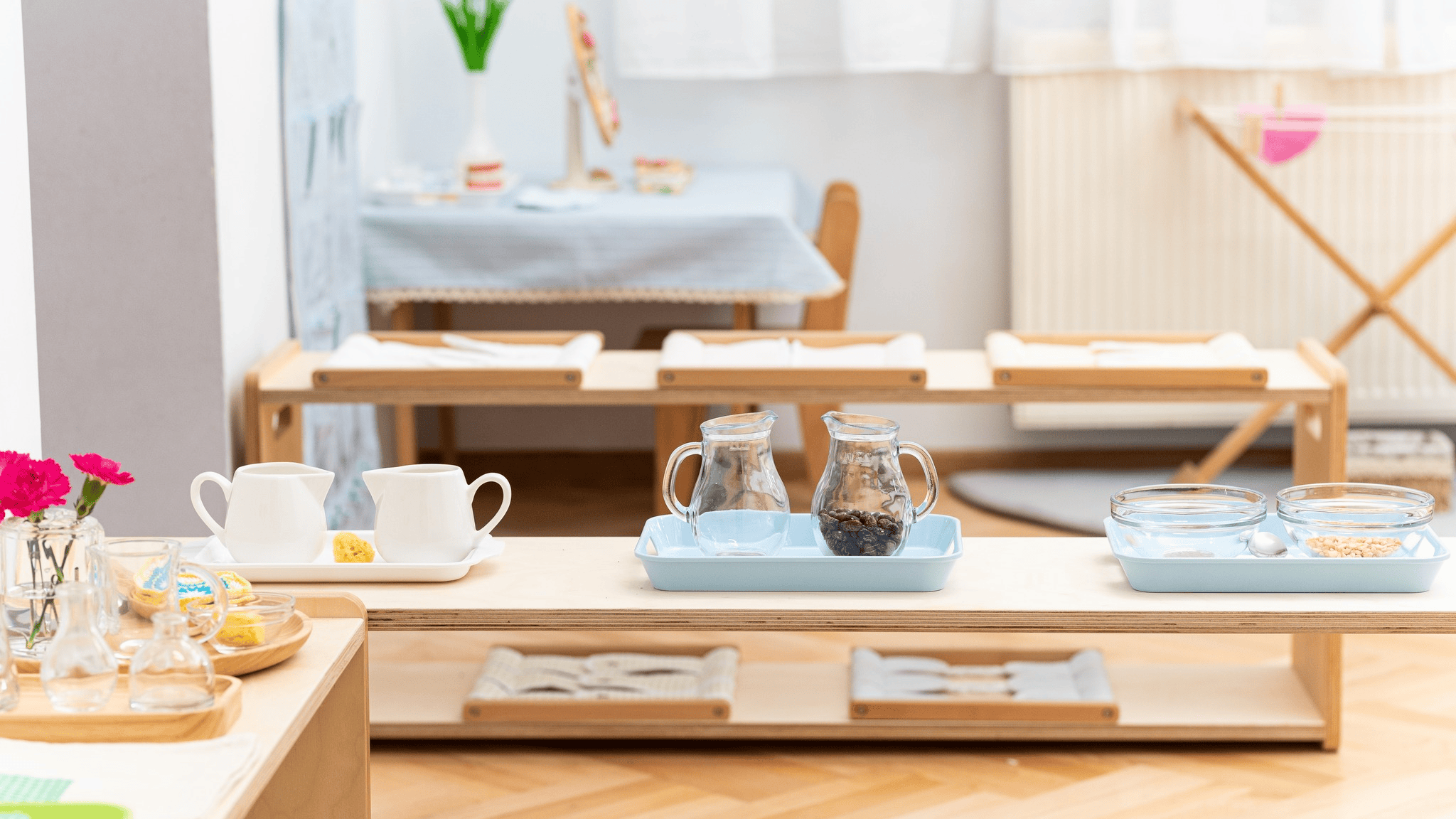
A child may spend twenty minutes pouring water from one pitcher to another.
Another child may carefully roll and unroll a work mat several times.
Some children return to the same material day after day.
To many adults, this can seem unnecessary or repetitive.
However, in Montessori education, repetition is not viewed as wasted time.
It is considered an essential part of child development.
Repetition Helps Children Build Concentration
Young children develop concentration differently from adults.
They do not build focus by being told to “pay attention.”
Instead, concentration develops naturally when children are given meaningful activities that match their developmental needs.
When a child repeats an activity by choice, they are not simply copying an action.
They are refining movement, testing understanding, and gradually gaining control over both mind and body.
Dr. Maria Montessori observed that repetition often appears during moments of deep developmental work.
The more engaged the child becomes, the more likely they are to repeat the activity.
Over time, this process strengthens:
attention span
hand-eye coordination
movement control
sequencing ability
patience and persistence
This is why Montessori classrooms protect uninterrupted work periods whenever possible.
Repetition Supports Independence
Children naturally seek independence.
However, independence is not achieved instantly.
It is built through repeated opportunities to practice real skills.
For example:
pouring water
buttoning clothing
carrying trays
cleaning a table
organizing materials
These activities may appear simple to adults, but for young children they involve multiple layers of coordination and cognitive development.
Through repetition, children gradually move from dependence to mastery.
Eventually, actions that once required full concentration become internalized abilities.
This process builds confidence because the child experiences genuine success through their own effort.
Repetition Allows Children to Self-Correct
One of the important principles in Montessori education is self-correction.
Rather than relying constantly on adult praise or correction, Montessori materials are often designed to help children recognize mistakes independently.
When children repeat an activity, they begin noticing details:
water spilling during pouring
imbalance while carrying objects
misplaced pieces in materials
sequencing errors
Instead of feeling discouraged, children naturally adjust and improve through practice.
This process develops problem-solving skills and resilience.
Children learn that mistakes are part of learning, not something to fear.
Why Montessori Classrooms Avoid Unnecessary Interruption
Adults often interrupt children without realizing it:
“Good job.”
“Try this instead.”
“Let’s move to another activity.”
But in Montessori education, interruption is approached carefully.
When a child is deeply engaged in repetition, important developmental work may be taking place internally.
Interrupting concentration too frequently can break the child’s focus and reduce opportunities for self-construction.
This is why Montessori guides are trained to observe before intervening.
The goal is not to control every moment, but to support the child’s natural developmental process.
Repetition Is Not Boredom
In adult life, repetition is often associated with boredom.
For children, however, repetition serves a very different purpose.
Young children repeat activities because they are building themselves through experience.
Each repetition strengthens neural connections, movement patterns, and internal order.
What may appear “simple” externally can actually represent complex developmental work internally.
In Montessori education, repetition is respected because it reflects the child’s natural drive toward growth, coordination, and independence.
Montessori education recognizes that children learn through active experience, not passive instruction.
Repetition is one of the ways children develop concentration, independence, confidence, and self-discipline.
Rather than rushing children from one activity to another, Montessori environments allow children the time and freedom to repeat meaningful work at their own pace.
Because sometimes, growth happens quietly — one repetition at a time.
 Back-to-School Anxiety: Montessori Tips for a Smooth Transition
 Back-to-School Checklist: Montessori Study Corner Setup | Adena Montessori
 Why Does Montessori Emphasize Repetition?
 How to Build a Montessori Christmas Shelf at Home: A Simple Guide for Parents