

Why Montessori Children Use Geometry Cabinet Before Writing | Pre-Writing Skills
How the Montessori Geometry Cabinet Builds Pre-Writing Skills Through Hands-On Learning
When parents first see a Montessori Geometry Cabinet, they often assume it's simply a material for learning circles, triangles, and squares.
In reality, the Montessori Geometry Cabinet is much more than a shape-recognition activity. It is one of the most important Montessori Sensorial Materials, carefully designed to prepare children for writing while developing visual perception and early geometric understanding.
Instead of asking children to copy letters before they are ready, Montessori education focuses on building the physical and cognitive skills that make writing natural and enjoyable.
For children aged 3–6 years, the Geometry Cabinet provides an ideal bridge between sensorial exploration and future handwriting.
What Is the Montessori Geometry Cabinet?
The Montessori Geometry Cabinet consists of a series of drawers containing wooden geometric insets, each fitted with a small knob that encourages a proper three-finger grip.
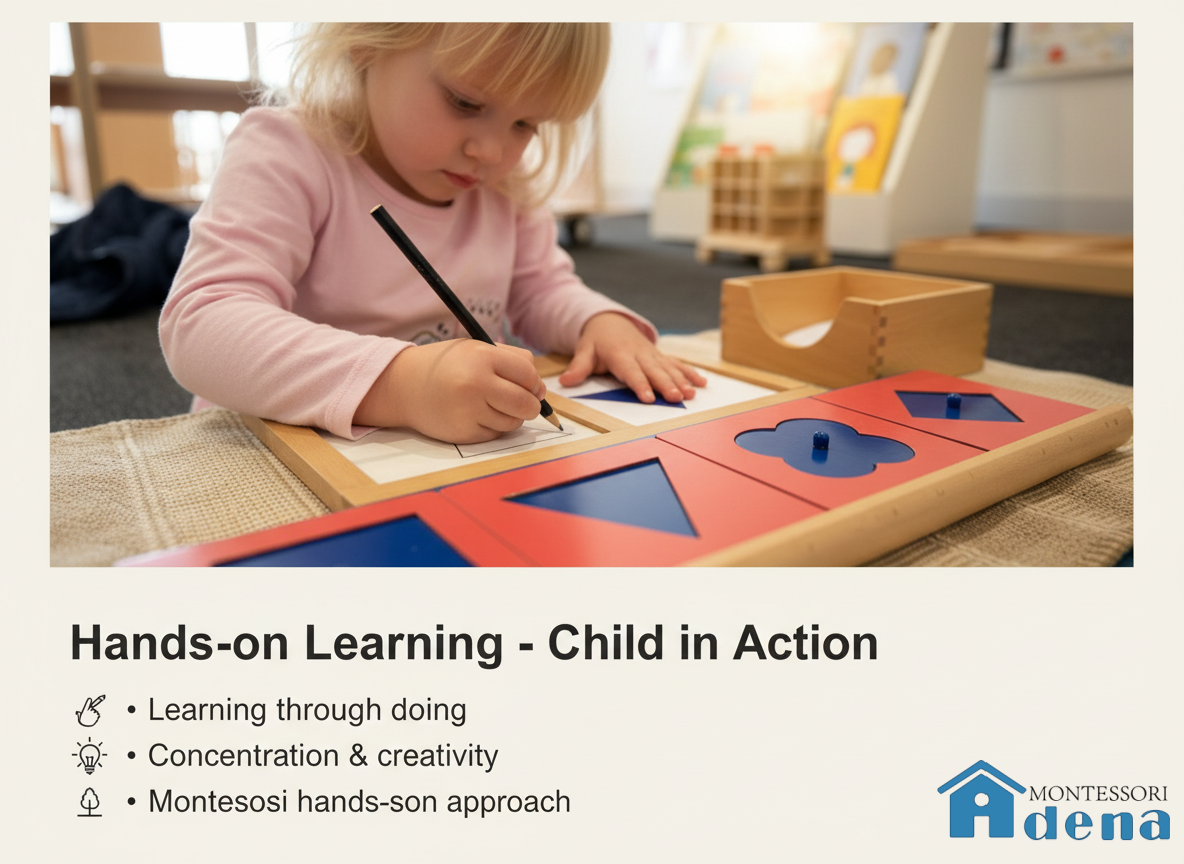
Children remove each inset, compare different shapes, replace them into the correct frame, and eventually trace the outlines onto paper.
Although the activity appears simple, every movement has a clear educational purpose.
Unlike traditional shape puzzles that focus only on naming shapes, the Geometry Cabinet develops the coordination, precision, and observation skills that children need before they begin writing.
Key Benefits of the Montessori Geometry Cabinet for Pre-Writing Development
Fine Motor Skills & Pencil Grip Readiness
One of the primary goals of the Montessori Geometry Cabinet is to strengthen fine motor skills.
Each time children grasp the knob, control the inset, or trace its outline, they refine the small muscles of the fingers, hand, and wrist.
These repeated movements naturally develop:
Fine motor coordination
Pencil grip readiness
Wrist stability
Finger strength
Controlled hand movements
Rather than practicing letters too early, Montessori children first prepare the hand to write.
Visual Discrimination for Early Learning
Strong handwriting begins with strong observation skills.
As children compare circles, ovals, triangles, quadrilaterals, and curved figures, they gradually learn to recognize subtle visual differences.
The Geometry Cabinet strengthens:
Visual discrimination
Shape recognition
Spatial awareness
Pattern observation
These abilities later support reading, writing, mathematics, and logical thinking.
Hand-Eye Coordination Through Purposeful Movement
Every activity in the Geometry Cabinet requires children to coordinate what they see with how they move.
By repeatedly placing, removing, rotating, and tracing each inset, children improve hand-eye coordination while developing greater precision and control.
This process also encourages concentration, patience, and independent work—core principles of Montessori education.
Building Early Geometry Concepts
The Geometry Cabinet introduces children to geometry through direct experience.
Instead of memorizing geometric terms, children explore similarities and differences between shapes by touching, comparing, and tracing them.
This hands-on approach lays a strong foundation for future mathematical learning and supports the Montessori principle of moving from concrete experience to abstract understanding.
Why Is the Geometry Cabinet Important Before Writing?
Many parents wonder why Montessori children spend so much time tracing geometric figures before learning letters.
The answer is simple:
Children cannot write confidently until they have developed the physical control required for writing.
The Geometry Cabinet helps children build the coordination, precision, and muscle memory necessary for handwriting.
As Dr. Maria Montessori wrote,
"The hand is the instrument of the mind."
Writing is not simply a language skill—it is the result of well-developed movement, concentration, and purposeful repetition.
How to Choose a High-Quality Montessori Geometry Cabinet
When selecting a Montessori Geometry Cabinet, quality matters.
Look for materials that include:
Precisely manufactured geometric insets
Smooth, child-safe wooden construction
Comfortable knobs for the three-finger grip
Accurate Montessori dimensions
Durable craftsmanship for daily classroom use
Well-made Montessori materials allow children to focus on learning rather than struggling with poorly designed equipment.
Why Educators Choose Adena Montessori
Since 2008, Adena Montessori has specialized in manufacturing authentic Montessori educational materials for schools, distributors, and educational brands worldwide.
Our Montessori Geometry Cabinets are produced according to Montessori standards using carefully selected materials and precision craftsmanship.
Every material is designed to support children's natural development while meeting the practical needs of modern Montessori classrooms.
Whether you are furnishing a new Montessori environment or sourcing educational materials for your business, Adena Montessori is committed to providing reliable, high-quality products that educators can trust.
Frequently Asked Questions
What does the Montessori Geometry Cabinet teach?
The Montessori Geometry Cabinet helps children develop fine motor skills, visual discrimination, hand-eye coordination, concentration, and early geometry concepts while preparing them for handwriting.
How does the Montessori Geometry Cabinet help with writing?
By tracing and manipulating geometric insets, children strengthen the muscles used for writing, improve pencil control, and develop the coordination required for handwriting.
At what age should children use the Montessori Geometry Cabinet?
The Geometry Cabinet is generally introduced to children between 3 and 6 years old, when they are developing fine motor control, visual perception, and readiness for writing.
Is the Montessori Geometry Cabinet part of the Sensorial curriculum?
Yes. The Geometry Cabinet is one of the classic Montessori Sensorial Materials. It refines children's visual perception while laying the foundation for later work in language and mathematics.
The Montessori Geometry Cabinet is far more than a collection of wooden shapes.
It develops the fine motor control, visual discrimination, and coordination children need before writing, while also introducing the foundations of geometry through meaningful, hands-on exploration.
Following the Montessori philosophy of learning through purposeful activity, the Geometry Cabinet helps children build confidence, independence, and a lifelong love of learning—one carefully guided movement at a time.
 Back-to-School Anxiety: Montessori Tips for a Smooth Transition
 Back-to-School Checklist: Montessori Study Corner Setup | Adena Montessori
 Why Montessori Children Use Geometry Cabinet Before Writing | Pre-Writing Skills
 Montessori Metal Insets: Why Children Use Them Before Writing